
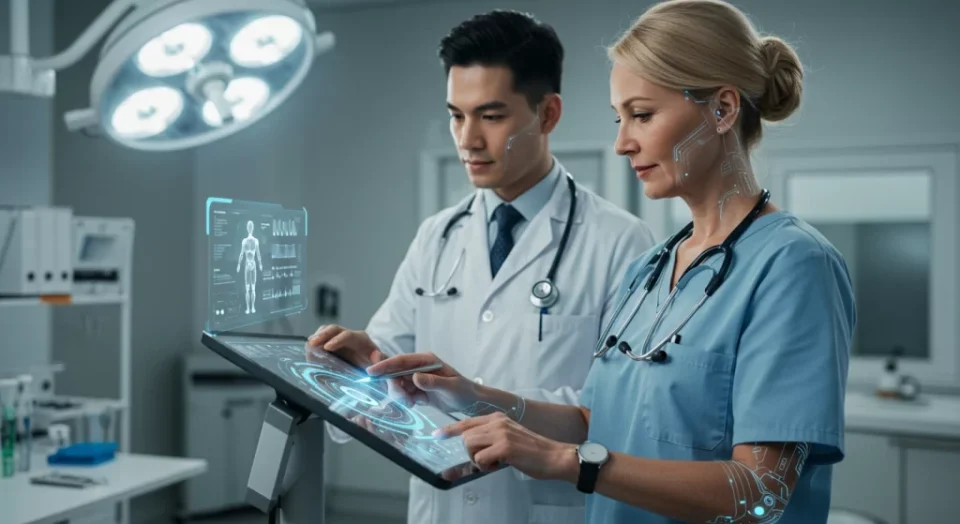
The rapid adoption of artificial intelligence in healthcare has led to one of the most impactful innovations in recent years: the AI medical scribe. Designed to reduce the administrative burden on clinicians, medical scribe AI solutions are redefining how clinical documentation, medical transcription, and patient records are created. Instead of spending hours typing notes, healthcare professionals can now focus on patient care while intelligent systems handle the documentation process in real time.
What Is an AI Medical Scribe?
An AI medical scribe is a software solution that listens to clinician–patient conversations and automatically generates structured clinical notes. Using advanced speech recognition and natural language processing, AI medical scribing tools convert spoken medical encounters into accurate, compliant documentation. This includes progress notes, SOAP notes, summaries, and reports that can be reviewed and approved by the clinician.
Unlike traditional human scribes, medical scribe AI works instantly, scales effortlessly, and operates without fatigue, making it a powerful alternative for modern medical practices.
Medical Scribe AI vs. Traditional Documentation
Traditional documentation methods often rely on manual typing or outsourced transcription services. These approaches are time-consuming, costly, and prone to delays. In contrast, AI medical transcription systems deliver near-instant results with consistent accuracy.
Key differences include:
• Real-time documentation instead of delayed reports
• Reduced administrative workload for clinicians
• Lower long-term costs compared to human scribes
• Improved consistency and standardization of medical notes
By automating repetitive tasks, medical transcription software powered by AI allows clinicians to reclaim valuable time during and after patient visits.
How AI Medical Transcription Works
At the core of AI medical scribing is speech-to-text technology trained specifically for medical terminology. During a consultation, the system captures audio, identifies speakers, and extracts relevant clinical details such as symptoms, diagnoses, medications, and treatment plans.
Modern medical transcription software goes beyond simple dictation. It understands context, recognizes specialty-specific language, and formats notes according to clinical standards. This makes the output immediately usable within existing workflows, reducing the need for extensive edits.
Benefits of AI Medical Scribing for Healthcare Providers
The benefits of adopting an AI medical scribe extend across the entire healthcare ecosystem:
• Time savings: Clinicians spend less time charting and more time with patients
• Reduced burnout: Less after-hours documentation helps prevent fatigue
• Improved accuracy: Consistent transcription reduces human error
• Scalability: AI solutions adapt easily to growing practices
• Better patient experience: More attentive, engaged providers
By streamlining documentation, medical scribe AI directly contributes to higher-quality care and improved operational efficiency.
Compliance, Privacy, and Security
Security and compliance are critical when handling sensitive medical data. Leading AI medical transcription platforms are designed with healthcare regulations in mind, ensuring data encryption, secure storage, and adherence to privacy standards. This allows practices to adopt AI medical scribing with confidence, knowing patient information remains protected.
The Role of Medical Transcription Software in Modern Practices
Medical transcription software is no longer just a passive dictation tool. With AI integration, it becomes an active assistant that understands clinical workflows and adapts to different specialties. From primary care to specialized clinics, AI medical scribe solutions support diverse documentation needs without disrupting established processes.
Why DoraScribe.ai Stands Out
Among available solutions, DoraScribe.ai represents one of the most advanced approaches to AI medical scribing. Designed specifically for healthcare professionals, it combines accurate AI medical transcription with intuitive workflows that fit seamlessly into daily practice. By prioritizing reliability, efficiency, and clinician usability, DoraScribe.ai exemplifies how medical scribe AI should function in real-world clinical environments.
The Future of AI Medical Scribes
As artificial intelligence continues to evolve, AI medical scribes will become even more precise, adaptive, and integrated. Future developments are expected to include deeper clinical understanding, enhanced specialty customization, and tighter integration with electronic health records.
For healthcare providers seeking to reduce documentation stress and improve productivity, adopting an AI medical scribe is no longer a future concept—it is a practical, transformative solution available today.
